Milwaukee M18 vs DeWalt 20V Drills: Which Wins? (October 2026)
For Milwaukee M18 vs DeWalt 20V, pick the Milwaukee 2606-21CT for its stated 500 in-lb torque rating, or the DeWalt DCD771C2 for its lower listed weight and 2 batteries. Your existing battery platform and the kit you need can settle the choice.
On this page (9 sections)
- Milwaukee M18 vs DeWalt 20V: which drill fits your work?
- Which kit gives you more useful runtime?
- How do the speed ranges compare?
- Which drill is better for home projects?
- Is the DeWalt DCD771C2 a better buy than the Milwaukee M18?
- Is the Milwaukee M18 2606-21CT worth choosing?
- What about a brushless drill from Makita?
- What mistakes should you avoid when choosing?
- How should you make the final choice?
For Milwaukee M18 vs DeWalt 20V drills, choose the Milwaukee M18 2606-21CT for its stated torque rating, or the DeWalt DCD771C2 for its lower listed weight and 2 batteries. Both are two-speed drill drivers for drilling and fastening, but the models differ in kit contents, battery platform and the measurements used to describe power.
Start with the battery system you already use. If you own compatible batteries and a charger, adding a tool from that platform can make a new kit more useful and avoid duplicating gear.
If you are starting fresh, compare the exact kit and the kind of work you expect to do.

 Best for brushless buyers
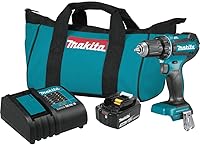
Makita XFD131 18V LXT Brushless Driver-Drill Kit
Milwaukee M18 vs DeWalt 20V: which drill fits your work?
The Milwaukee suits buyers who prioritize its stated torque and a hard case; the DeWalt suits buyers who want a lighter listed tool and 2 batteries in the kit. Those are practical differences you can weigh against your jobs, carrying needs and existing tools.
The Milwaukee 2606-21CT lists 500 in-lb of torque and two speed ranges, from 0-400 to 0-1,800 RPM. The DeWalt DCD771C2 lists 300 UWO and two speed ranges, from 0-450 to 0-1,500 RPM.
UWO and in-lb are different kinds of measurements. Don't treat DeWalt's UWO figure as a torque rating, or use the two numbers as a direct ranking of which drill is stronger.
The listed tool weights are 3.6 lb for DeWalt and 6.3 lb for Milwaukee. For work above shoulder height, repeated drilling or carrying tools between rooms, weight can be one part of your decision; how a tool balances in your hand matters too.
The Milwaukee has the stronger case if its torque figure is your priority, but a single rating doesn't make it the best fit for every task. The DeWalt may be the simpler choice if you value its included batteries and lower listed weight more.
Which kit gives you more useful runtime?
The DeWalt kit description includes 2 batteries, while the Milwaukee kit includes 1. An extra battery can let you swap packs when one needs charging, though it doesn't promise a fixed amount of runtime.
Runtime changes with the battery's charge and the work you ask the drill to do.
Milwaukee includes a hard case and a fuel gauge. DeWalt's kit description includes a charger and storage bag alongside its batteries, so consider how you carry and store your tools as well as how many packs are in the box.
The capacity figures provided for these two batteries are 1.3 for DeWalt and 1.5 for Milwaukee, with no unit specified. They aren't enough to predict which kit will run longer, so don't choose between them based on those figures.
If you own compatible batteries already, count those alongside the kit contents. A single-battery kit may be enough when another charged battery is close at hand, while a second included pack can be useful if you work away from your charger.
Before buying, check the model number and make sure the batteries and charger match the drill you intend to use. Our cordless drill buying guide explains how to compare a kit with your day-to-day jobs.
Will Milwaukee M18 batteries work in a DeWalt 20V drill?
No, choose batteries and chargers for the matching tool and platform. The Milwaukee kit uses the M18 system, and the DeWalt kit belongs to the 20V MAX platform.
The Milwaukee 2606-21CT is listed as compatible with M18 and M12 batteries and an M18 and M12 multi-voltage charger. That compatibility detail doesn't make its battery interchangeable with DeWalt 20V MAX tools.
The DeWalt kit includes a DCD771C2 drill and charger. If you plan to add batteries separately, check the exact battery and tool compatibility before you order.
Staying with one platform makes sense when you already have useful batteries, chargers and other tools from that system. If you're choosing your first cordless tools, look beyond this single drill and consider what else you want the batteries to power.
How do the speed ranges compare?
Milwaukee has the higher listed top speed, while DeWalt has the slightly higher low-speed figure. Either model gives you two speed settings for drilling and fastening, so select the range that suits your bit and task.
Milwaukee lists ranges of 0-400 and 0-1,800 RPM. DeWalt lists ranges of 0-450 and 0-1,500 RPM.
These figures describe rotation speed, not a guaranteed result in every material or with every bit.
Start slowly enough to keep the bit in place, then increase speed as the work allows. For driving screws, use a suitable setting and keep the bit aligned with the screw head.
If the bit slips, stop and reset it instead of forcing the drill.
The Milwaukee's torque rating can help you compare its stated fastening capability, but it doesn't mean every fastener should be driven at full force. Use the clutch or other controls as appropriate for the task and material.
Our guide to what the numbers on a drill mean explains how to approach drill settings.
Which drill is better for home projects?
For varied household jobs, choose the kit whose weight, batteries and controls fit the way you'll work. Both models have two speed ranges for drilling and fastening, so your choice can come down to carrying and battery needs.
The DeWalt is a reasonable fit for furniture assembly, shelves and routine repairs if its lower listed weight and 2 batteries appeal to you. Its compact design is intended to fit into tight areas, which can help when a cabinet, stud or nearby surface limits room to work.
The Milwaukee can suit a home user who values its stated torque figure, fuel gauge and hard case. Its one included battery is a consideration if you expect long work sessions away from a charger and don't have another compatible battery.
For either model, use the correct bit and keep the drill steady as the bit engages. A drill is not automatically the right tool for every material.
Masonry work may call for a hammer drill depending on the material and hole size; see our guide to using a hammer drill at home.
When drilling metal, choose a suitable bit, secure the work and keep the tool under control. Our guide to drilling through metal with a cordless drill covers useful steps for that job.
Is the DeWalt DCD771C2 a better buy than the Milwaukee M18?
Choose the DeWalt DCD771C2 when lower listed weight and 2 included batteries matter more to you than Milwaukee's stated torque figure. Its two-speed transmission and compact design suit a general-purpose kit for jobs around the home.
The DCD771C2 has a 1/2 in single-sleeve ratcheting chuck, which grips a bit, and an ergonomic handle for comfort and control. It also has a high-performance motor rated at 300 UWO.
That output figure describes power ability, not an in-lb torque rating.
Choose a different drill if a particular task calls for a feature this basic drill driver doesn't provide. For example, drilling masonry can call for a hammer drill, while repeated screw driving may be easier with an impact driver.
Compare the jobs you actually do before paying for a tool type you may rarely need.
Is the Milwaukee M18 2606-21CT worth choosing?
Choose the 2606-21CT if you want an M18 drill with a 500 in-lb torque rating, two speed ranges and a hard case. Its kit includes 1 battery, so it fits best if that is enough for your work or you already have compatible batteries.
Milwaukee includes overload protection and a fuel gauge among its features. The drill is specified to operate down to 0°F.
Follow the tool and battery instructions for use, charging and storage, especially when working in cold conditions.
Skip this kit if you need two batteries included or put a lower listed weight ahead of the M18 features. The DeWalt's kit contents may better suit those priorities, provided its platform fits your needs.
What about a brushless drill from Makita?
The Makita XFD131 is a separate 18V LXT option for buyers who want a brushless drill and use, or plan to choose, that battery platform. It has a 440 in-lb torque rating, two speed ranges and a 3.0Ah battery.
Its kit includes a charger and tool bag. The XFD131 isn't part of either the Milwaukee M18 or DeWalt 20V MAX platform, so factor in the added battery system if you're comparing it with those two drills.
Choose it as a platform decision as well as a drill decision. If you already own Makita 18V LXT batteries, its compatibility may be useful; if you don't, compare the cost and usefulness of adding that system against staying with Milwaukee or DeWalt.
For another Milwaukee platform comparison, our Milwaukee M18 vs M12 guide explains which system may fit your work. For more drills in the same family, see the best Milwaukee cordless drills.
What mistakes should you avoid when choosing?
Don't choose by brand name, top speed or a single number alone. Check the model, platform, kit contents and the work you expect the drill to handle.
One common mistake is comparing UWO directly with in-lb torque. They use different units, so those figures don't give you a direct winner between these models.
Compare each tool's stated features with your needs instead.
Another mistake is assuming that batteries cross between brands. They don't: match each battery and charger to the right platform and check compatibility for the exact tool.
Finally, don't assume every kit from the same brand includes the same pieces. Confirm the model number, battery count, charger and case or bag before you buy.
If you plan to drill masonry, check whether a basic drill driver suits the job or whether a hammer drill is a better fit.
How should you make the final choice?
Pick the DeWalt DCD771C2 for its lower listed weight and 2 batteries; pick the Milwaukee M18 2606-21CT if its stated torque rating and hard case match your priorities. Choose the Makita XFD131 if you want its brushless motor and 18V LXT battery platform.
For this Milwaukee M18 vs DeWalt 20V decision, start with the battery system you own or want to build, then compare the kit contents and features that matter for your regular jobs. Check the exact model number and included charger before ordering.
If neither compared platform suits your plans, explore the best Makita cordless drills for another system to consider.
Frequently asked questions
Is Milwaukee M18 better than DeWalt 20V?
Milwaukee M18 fits you if you prioritize a 500 in-lb torque rating and a hard case. The DeWalt DCD771C2 fits buyers who value lower listed weight and 2 included batteries.
Compare the exact kit contents and battery system before choosing.
Which drill has more torque, Milwaukee or DeWalt?
The Milwaukee M18 2606-21CT has a 500 in-lb torque rating. The DeWalt DCD771C2 has a 300 UWO power output figure, not an in-lb torque figure, so the numbers aren't directly comparable.
Are Milwaukee M18 and DeWalt 20V batteries interchangeable?
No. The Milwaukee kit is part of the M18 system, while the DeWalt kit uses the 20V MAX platform.
Use batteries and chargers compatible with the matching system, and check compatibility for the exact tool and battery.
Should I choose a brushless drill?
A brushless drill may suit you if you want the motor design and features of a specific model. The Makita XFD131 has a brushless motor and a 440 in-lb torque rating.
Compare its battery platform and kit contents with your current tools.
What should I compare before buying a drill kit?
Compare the exact model, included batteries, charger, case or bag, speed ranges and the work you do most. Check which battery platform you already own.
Kits from the same brand can have different contents, so check the model number.